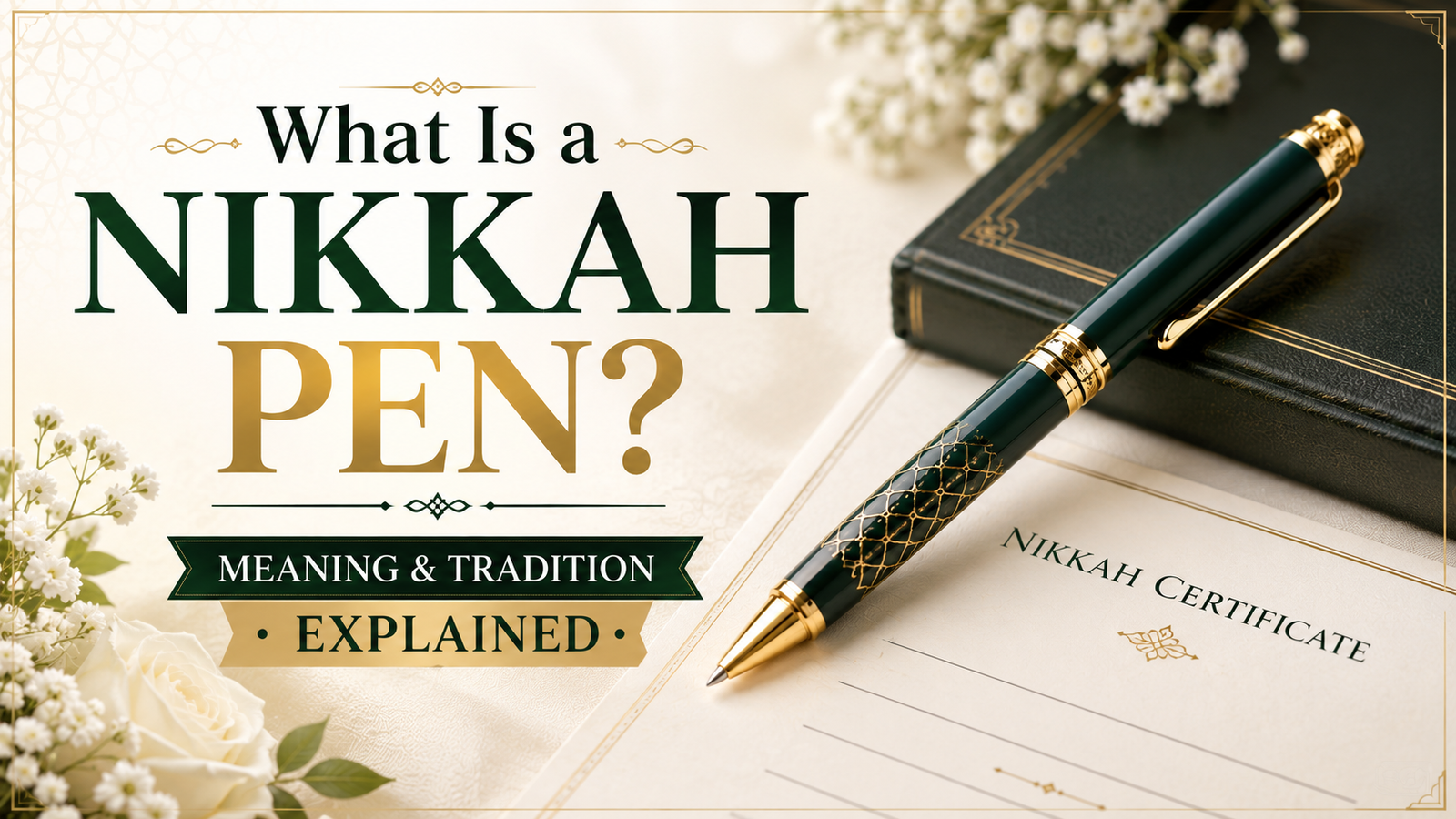
A Nikkah pen is the pen used to sign the Nikkah Nama (the official Islamic marriage contract) during the Nikkah ceremony. It’s usually held by the groom, the bride, or the witnesses at the exact moment the marriage is formalized, and unlike the pen sitting in a drawer at the registrar’s office, it’s chosen on purpose.
It’s often decorative, sometimes engraved with a name, sometimes tied with ribbon or dried flowers. It’s a small detail, but it’s the object in your hand during one of the most legally and emotionally loaded minutes of the day.
Where does this actually come from?
Honestly? It’s not some centuries-old custom passed down through generations. Signing a Nikkah Nama is old; the contract itself is a core part of Islamic marriage law. But the idea of a special pen for it is newer, and it’s grown alongside the same trend that gave us custom wedding invitations, personalized hampers, and matching “Mr & Mrs” everything.
Once couples started treating the signing table as a photo moment instead of just paperwork, the pen became part of the styling. Give it another decade, and people will probably assume it’s ancient, too. That’s just how traditions get made.
That said, the underlying moment it marks is real and serious. The Nikkah is the contract, not the walima or the baraat. Everything else on the wedding calendar is celebration; this is the part with actual legal and religious weight. A nicer pen doesn’t change that. If anything, it’s a way of marking that this specific minute matters more than the rest of the day.
What happens with it during the ceremony
The Nikkah Khwan (the person officiating) reads out the terms of the marriage (the mahr, the conditions both families have agreed on) and asks the bride and groom to accept, usually three times, with the words “Qabool Hai.” Once that’s done, the Nikkah Nama gets signed: bride, groom, witnesses, sometimes the wali (guardian) too. That’s the moment the pen shows up. Some families keep it simple and pass around whatever pen is on the table. Others set it up ahead of time, one pen for the groom, sometimes a matching one for the bride, occasionally a whole little tray with the certificate, the pen, and a stand.
It’s a small window (the actual signing takes maybe two minutes), but it’s the part people photograph. If you’ve ever seen a Nikkah photo where someone’s holding a pen with a bow on it or feathers coming off the end, that’s exactly what we’re talking about.
Why do people bother with a “special” one
A few reasons, honestly, and they’re not mutually exclusive:
- It photographs well. A plain ballpoint doesn’t do much in a picture. A pen with gold detailing, or a feather quill style, gives the signing moment the same visual treatment as the rest of the wedding.
- It can carry a name. Engraving the groom’s or bride’s name (or both) turns it from “a pen” into a keepsake, something that goes in a memory box afterward instead of back in a drawer.
- “Qabool Hai” itself gets engraved sometimes. It’s a nice touch: the exact words said during the ceremony, printed right there on the thing you’re holding while you say them.
- It’s genuinely one of the cheaper ways to add something meaningful to the day. Compared to almost anything else on a wedding budget, a nice pen is not where the money goes.
The styles people usually go for
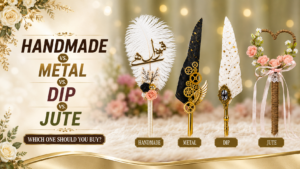
At Qalam Nigar we make four kinds, and each tends to suit a different mood rather than a different budget tier:
- Handmade Nikkah Pens: the flagship line, made by hand rather than mass-produced, is good for couples who want something that feels crafted rather than ordered off a shelf.
- Dip Nikkah Pens: quill-style, feathers, a bit of an antique feel. Suits a classic or old-world theme.
- Metal Nikkah Pens: chrome, gold, rose gold, sometimes with gem detailing. Pick if you want something sleek rather than rustic.
- Jute Nikkah Pens: rope, florals, a heart shape here and there. Works well for an outdoor or rustic-themed Nikkah.
You can browse the full Nikkah Pen collection if you want to see all four side by side before deciding.
A small practical note
If you’re planning to get one personalized (a name, a date, “Qabool Hai”), order it with enough lead time. Custom pens are made to order, not pulled off a shelf, so last-minute isn’t really an option once engraving is involved. Most people order a few weeks out from the Nikkah date, not a few days.
FAQs
Is a Nikkah pen religiously required?
No. The requirement is the signed Nikkah Nama itself, witnessed properly. The pen used to sign it has no religious significance. A decorative pen is purely a styling and keepsake choice, not part of Islamic marriage requirements.
Who actually uses the pen: bride, groom, or both?
Usually both sign, along with the witnesses, so the pen (or a matching pair) typically gets passed around the signing table rather than used by just one person.
Can I keep the pen after the ceremony?
Yes, most couples keep it as a keepsake afterward rather than treating it as a disposable prop, especially if it’s been personalized with a name or date.